The UAE’s national agenda is not a branding exercise. We the UAE 2031 — the government’s comprehensive vision for transforming the country into a global knowledge hub — places human capital development at the centre of every strategic pillar. For HR directors, L&D leaders, and executives running organisations in Dubai, that national ambition translates into a direct operational question: do your leaders have the capabilities to execute in this environment, or are they managing the present while the economy around them shifts?
Leadership development in Dubai has never been more commercially urgent. Organisations that treat leadership training as a compliance exercise — a two-day course, a slide deck, a certificate — are building a capability gap at the exact moment the market demands the opposite. This article sets out what the vision actually requires, why conventional training falls short, and what a practical approach to building real leadership capability looks like.
What We the UAE 2031 Means for Organisations in Dubai
We the UAE 2031 is structured around four main pillars, with the development of a knowledge-based economy and the empowerment of UAE human capital running through each of them. The vision, published by the UAE Cabinet, frames the country’s ambition to diversify beyond oil dependence by building world-class institutions, a skilled workforce, and innovation-driven industries — with Dubai positioned as the global city at the centre of that transformation.
For businesses operating in Dubai, this creates a specific organisational pressure. Government strategy, foreign direct investment patterns, and talent attraction all accelerate simultaneously. The sectors experiencing the fastest growth — technology, financial services, professional services, healthcare, and logistics — are exactly the sectors where leadership quality determines whether an organisation captures opportunity or loses ground to faster-moving competitors. A national vision of this scale does not raise the bar abstractly. It raises the bar for every leadership decision made inside every organisation that operates within it.
The practical implication is this: organisations that align their leadership investment with the direction of the economy will attract better talent, execute strategy more consistently, and build the kind of reputation that opens doors in a relationship-driven Gulf business culture. Those that don’t will find the gap between their leadership capability and market expectation widening — quietly, and then suddenly.
Why Standard Leadership Training Does Not Build the Capability the Vision Requires
Most leadership training in the corporate market shares a structural flaw: it separates learning from the context where decisions actually happen. A leader attends a programme, absorbs frameworks, returns to the office, and faces the same pressures with the same instincts they had before. The transfer problem — the well-documented gap between what people learn in training rooms and what they apply in real work — is not a minor inefficiency. It is the reason most leadership development spending produces disappointing results.
The Forward Economy pillar of We the UAE 2031 calls for adaptive, innovation-oriented organisations. That capability cannot be built through passive instruction. Adaptive thinking is developed through practice under pressure — through real decisions with real consequences, even if those consequences are simulated. The research on experiential learning, grounded in David Kolb’s learning cycle framework, consistently shows that adults retain and apply skills far more effectively when they learn through direct experience, reflection, and active experimentation than through traditional didactic methods. This is not a pedagogical preference. It is a measurable difference in outcomes.
The leaders Dubai organisations need for the next decade are those who can manage complexity, make decisions with incomplete information, align diverse teams across cultural and functional boundaries, and sustain performance through change. None of these capabilities develop in a classroom. They develop in conditions that approximate real pressure — and then deepen through structured reflection on what happened and why.
The Three Gaps Most Dubai Organisations Are Not Addressing
When L&D leaders in Dubai examine their leadership pipeline honestly, three gaps tend to surface repeatedly:
- The first-time manager gap — high performers promoted into leadership roles who have no experience managing ambiguity, conflict, or team performance, and who receive minimal structured development at the most critical transition of their career.
- The strategic alignment gap — mid-level leaders who are operationally competent but unable to connect their team’s work to the organisation’s broader direction, creating execution drag on even well-designed strategies.
- The culture-under-pressure gap — leaders who maintain the right behaviours in stable conditions but revert to directive or avoidant patterns when the organisation faces change, growth, or adversity.
These gaps are not abstract. They show up in attrition rates, in delayed decisions, in teams that lose energy when a capable manager moves on. Addressing them requires development that puts leaders into precisely the conditions where those gaps are exposed — and that provides structured support to build better responses.
How Experiential and Simulation-Based Training Builds Real Leadership Capability
Experiential learning in a corporate context refers to structured programmes in which participants build capability by doing — by working through realistic business scenarios, team challenges, or strategic simulations — rather than by listening or reading. The distinction matters because the learning happens in the doing and in the structured reflection that follows, not in the content delivered by a facilitator.
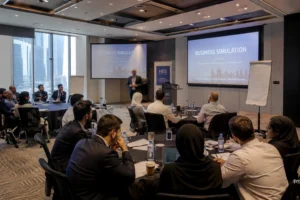
Business simulations are one of the most powerful tools in this category for leadership development. A well-designed simulation recreates the conditions of real organisational decisions: competing priorities, incomplete information, time pressure, and stakeholder dynamics. Participants make choices, experience consequences, and then debrief those choices with structured analysis. The learning is immediate, contextual, and tied to the real decisions the leader will face back in their role.
For Dubai organisations building leadership capability aligned with the demands of a knowledge-based economy, simulation-based programmes offer several specific advantages:
- Speed of development — leaders acquire and apply skills faster because the learning is active and contextual from the first session.
- Cultural applicability — simulations can be designed to reflect the specific industry, organisational context, and team dynamics of UAE businesses, rather than importing generic Western frameworks that require translation.
- Measurability — decision quality, collaboration patterns, and leadership behaviour are observable and coachable within the simulation, giving HR and L&D leaders concrete data on where gaps exist and whether they are closing.
- Retention and transfer — skills practised under realistic conditions transfer to the workplace at significantly higher rates than skills learned through passive instruction.
- Team-level impact — when a leadership cohort goes through a simulation together, the shared experience becomes a reference point that improves how they work with each other back in the business.
A leadership development programme that combines immersive simulations with personalised learning journeys — structured over time, not delivered in a single event — creates the conditions for sustained behavioural change. That is the difference between a training spend that feels good and a leadership investment that produces measurable business outcomes.
If you are designing or reviewing your leadership development strategy for 2025 and beyond, the approach matters as much as the content. Explore how HDS Learning designs leadership experiences for Dubai organisations.
Aligning Your Leadership Investment with the UAE’s Human Capital Agenda
The human capital development priority within We the UAE 2031 reflects a deliberate government position: that the Emirates’ long-term economic competitiveness depends on the quality of its workforce and leadership — not just its infrastructure or capital markets. For organisations in Dubai, aligning with this priority is not about positioning statements. It is about building a leadership pipeline that can genuinely execute on growth ambitions in a market that is moving fast.
Three practical principles should guide how organisations approach leadership development in this context.
Prioritise behavioural outcomes over training hours. The question is not how much development your leaders receive — it is whether their behaviour, decision-making, and impact are measurably improving. Design programmes around observable capability shifts, and measure those shifts over time.
Build learning into the flow of work. The most effective leadership development programmes are not isolated events. They are structured journeys that combine intensive experiences — simulations, workshops, facilitated challenges — with on-the-job application, reflection, and coaching. The UAE’s knowledge economy context rewards continuous learning cultures, and leadership programmes should model that approach.
Account for the cultural complexity of Dubai’s workforce. Teams in Dubai are among the most internationally diverse in the world. Effective leadership here requires specific capabilities: the ability to build psychological safety across cultural difference, to communicate expectations clearly across language and cultural backgrounds, and to align teams that hold different assumptions about hierarchy, feedback, and decision-making. Leadership development that ignores this context prepares leaders for a different city.
These principles are not aspirational — they are the practical requirements for leadership capability that can actually support an organisation’s growth in Dubai’s current environment. Organisations that invest in leadership development designed around these principles build a compounding advantage. The leaders they develop attract other strong performers, execute strategy more reliably, and retain the institutional knowledge that drives sustained performance.
Frequently Asked Questions
What is the connection between We the UAE 2031 and corporate leadership training?
We the UAE 2031 sets human capital development as a central national priority, positioning the UAE as a knowledge-based economy. For businesses in Dubai, this means the market rewards organisations with adaptive, high-capability leadership teams. It creates both the competitive pressure and the talent expectations that make structured leadership investment a business priority — not an HR activity. HDS Learning is a private training provider; its programmes align with this market context but are independent of the government initiative itself.
Why is experiential learning more effective than conventional training for leadership development?
Experiential learning builds capability through practice under realistic conditions rather than passive instruction. Research on adult learning consistently shows that skills developed through direct experience, structured reflection, and active experimentation transfer to real work at significantly higher rates than skills absorbed through lectures or workshops alone. For leadership — where the critical capabilities are behavioural and contextual — this difference in transfer rate is the difference between training spend that changes behaviour and spend that doesn’t.
What types of organisations in Dubai benefit most from experiential leadership development?
Organisations in sectors experiencing significant change or growth — including financial services, technology, healthcare, logistics, FMCG, and professional services — see the strongest returns. The programmes are particularly valuable for organisations scaling their Dubai operations, integrating new leadership teams following mergers or restructuring, or building a pipeline of first-time managers and mid-level leaders for the first time.
How long does a corporate leadership development programme typically take to show results?
Behavioural change takes time. A single simulation or workshop can shift awareness and build specific skills in a short period. Sustainable change in how leaders operate — the decisions they make, the conversations they have, the cultures they build — requires structured development over months, not days. Well-designed programmes combine intensive experiential interventions with sustained follow-through: coaching, reflection, and application back in the role.
What makes leadership training relevant specifically for Dubai’s business environment?
Dubai’s workforce is among the most internationally diverse in the world. Effective leadership here requires capabilities — cross-cultural communication, building trust across difference, navigating diverse team dynamics — that standard leadership frameworks rarely address directly. Programmes designed with the UAE business context in mind are more applicable and produce stronger results than imported content adapted from markets with very different workforce compositions.
How do HR and L&D leaders measure the impact of leadership development programmes?
The most reliable measures are behavioural: observable changes in how leaders make decisions, handle conflict, give feedback, and align their teams. Effective programmes build in measurement from the start — through pre- and post-programme assessment, manager observation, and team-level performance indicators. Simulation-based programmes offer an additional advantage: leadership behaviour is visible and coachable within the simulation itself, giving facilitators and L&D teams concrete evidence of where change is happening.
Building Leadership Capability That Matches Dubai’s Ambition
Dubai’s growth trajectory is not slowing. The organisations that will perform over the next decade are those building leadership capability now — not in response to a crisis, but in anticipation of the demands that national and market ambition will place on their teams. We the UAE 2031 sets the direction. The capability to execute on that direction is built by leaders who have been developed to think, decide, and lead in conditions of real complexity — not by leaders who attended a workshop and received a certificate.
The approach matters. Experiential learning programmes, business simulations, and personalised learning journeys are not premium features of leadership development. They are the mechanism through which leadership capability actually builds. If your organisation is investing in leadership training in Dubai, the question worth asking is not whether you are spending enough — it is whether the method you are using can actually produce the leaders your strategy requires.
HDS Learning designs immersive experiential programmes and learning journeys for organisations building leadership capability in Dubai and across the UAE. If you are reviewing your leadership development strategy and want to understand what a programme designed around real behavioural change looks like, connect with the HDS team to start the conversation.