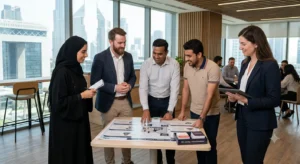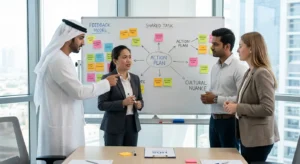
Effective soft skills training in the UAE requires cultural adaptation at the design level — not as an afterthought. The UAE workforce is one of the most nationally diverse on the planet, with expatriates making up a substantial majority of the total labor force. When an HR or L&D leader deploys a leadership communication program built for a Western corporate audience and runs it unchanged in Dubai or Abu Dhabi, the program does not just underperform — it can actively undermine the trust and psychological safety that effective training depends on. This article gives practitioners a concrete framework for what cultural adaptation actually means in training design for the Gulf.
Why Generic Soft Skills Training Fails in the UAE Context
Cultural adaptation in soft skills training UAE programs is not about adding a local photo to a slide deck. It is about recognizing that the cognitive and behavioral frameworks baked into most Western training curricula carry cultural assumptions that do not map cleanly onto a workforce spanning Emirati nationals, South Asian professionals, Arab expatriates, and Western executives — all sitting in the same room.
The most widely applied academic tool for understanding these gaps is Geert Hofstede’s cultural dimensions model, which scores countries on axes including power distance (acceptance of hierarchical authority), individualism versus collectivism, uncertainty avoidance, and long-term orientation. The UAE scores notably high on power distance compared to typical Northern European or North American benchmarks. That single variable changes how employees receive feedback, challenge a manager’s position in a group setting, or engage with peer-to-peer coaching exercises — three staple components of most leadership and communication training programs.
A facilitator who invites a junior team member to publicly critique a line manager’s decision — standard in many Western feedback models — may inadvertently create discomfort or even professional risk for both parties. The problem is not the individual. The problem is a training design that did not account for the cultural operating system the participants bring into the room.
Mid-funnel CTA: Want to explore how HDS Learning designs culturally intelligent experiential programs for UAE organizations? Discover our approach and the team behind it.
High-Context vs. Low-Context Communication: The Most Practical Design Variable
One of the most immediately actionable frameworks for L&D leaders adapting soft skills training in Dubai and the wider UAE is Edward Hall’s high-context versus low-context communication model. Understanding where your participant groups sit on this spectrum shapes every exercise you design.
Low-context communication cultures — the US, Germany, the Netherlands, Australia — favor explicit, direct verbal communication. Instructions are spelled out. Feedback is stated plainly. Disagreement is expected in professional discourse and is not read as personal. Most commercially available soft skills curricula are designed by and for low-context cultures.
High-context communication cultures — common across Arab, South Asian, East Asian, and many African contexts — rely significantly on shared understanding, non-verbal cues, relationship context, and indirectness. In high-context settings, what is not said often carries as much weight as what is. Conflict is frequently managed through intermediaries rather than direct confrontation. Public face preservation matters enormously.
The UAE workplace is not uniformly one or the other. It is a blend. An Emirati national, an Indian engineer, a British manager, and a Filipino team leader may all be in the same cross-cultural communication training session in Dubai — each bringing different defaults. Training that treats this as a uniform group will produce uniform disengagement.
Practical design moves for cross-cultural communication training UAE programs
When adapting communication training for this environment, four design decisions matter most:
- Restructure feedback exercises away from public critique toward structured written reflection or triadic coaching formats, where feedback is shared peer-to-peer rather than to the group.
- Reframe assertiveness content — reposition assertiveness not as “speaking up loudly” but as “clarity of contribution,” which resonates across both high- and low-context participants without implying that one style is superior.
- Use scenario-based simulation rather than role-play with named archetypes — simulation allows participants to engage with the behavior without feeling exposed or stereotyped.
- Build relationship time into the program architecture — high-context participants learn and trust within relationships; compressing all learning into task-focused modules without social connection is a structural design error.
Hierarchy, Leadership Norms, and What They Mean for Leadership Training in the Gulf
Leadership training programs in the Gulf — whether in Dubai, Abu Dhabi, Riyadh, or Jeddah — operate inside organizations where hierarchy is a functional and often respected part of the culture, not simply a bureaucratic artifact. Misreading this leads to poorly designed leadership development programs that create resistance rather than capability.
In many GCC organizations, particularly those with significant Emirati or Arab leadership layers, decision-making is often consultative but ultimately centralized. Consensus is sought through relationship and coalition rather than open debate in a meeting room. For a first-time manager program, this means that content on “how to run a participatory decision-making meeting” may need to be framed differently — not abandoned, but adapted to show how inclusive leadership behaviors function within a hierarchical structure, rather than as an alternative to it.
Multicultural team training in the UAE also needs to address the reality that many teams are managing significant power asymmetries tied not just to role, but to nationality. In some organizations, structural biases mean that employees from certain national backgrounds are over-represented in middle and junior layers, while others dominate senior roles. Effective leadership development programming acknowledges this dynamic openly in the facilitation design — using experiential methods that equalize participation without requiring anyone to violate their cultural norms.
Emirati workplace culture: specific considerations for L&D designers
Emirati professionals in corporate training settings bring a distinctive set of values and expectations that well-designed programs explicitly account for:
- Relationship as prerequisite to learning — building personal connection before task is not a delay; it is the learning infrastructure.
- Islamic values and time observance — program scheduling, break structures, and mixed-gender facilitation formats require specific planning.
- National identity and professional pride — case studies and scenarios that position UAE organizations as lagging behind Western counterparts in any way are received poorly and undermine trust in the facilitation team.
- Preference for storytelling over data-heavy slides — narrative-led facilitation methods align more naturally with Emirati communication norms than dense analytical frameworks.
Designing for the Expatriate Workforce: Dubai’s Multicultural Team Reality
Dubai’s corporate population is one of the most heterogeneous in the world. A single floor of a financial services firm in DIFC might hold professionals from many different nationalities. This is not a curiosity — it is the operating environment that soft skills training in Dubai must be designed for.
For HR leaders running cross-cultural communication training UAE-wide, the risk is designing programs that implicitly center one cultural group’s norms while framing others as “differences to be managed.” Effective multicultural team training instead positions cultural diversity as a performance variable — a design feature that, when understood and leveraged, produces better decisions and stronger teams.
Experiential learning is particularly well-suited to this context. Business simulations and structured team challenges create shared behavioral data — everyone can observe how the group made a decision, handled conflict, or communicated under pressure — without requiring anyone to make abstract claims about their own cultural background. The debrief after a simulation generates the cultural insight organically, from real behavior, rather than from a slide presenting cultural stereotypes.
This approach directly addresses the Content Gap Analysis finding that “no content [on hdslearning.com] addresses the specific dynamics of training in UAE — multicultural workforces, leadership norms in the GCC, Arabic-English bilingual teams.” Programs built on experiential learning and immersive simulation have a structural advantage here: the methodology itself equalizes participation and generates insight from behavior rather than from national generalizations.
A Practical Checklist for L&D Leaders Adapting Soft Skills Programs for the UAE
Before deploying or commissioning any soft skills training program in the UAE — whether in communication, leadership, negotiation, or feedback — L&D leaders should run through these design verification questions:
- Participant mapping: What is the cultural composition of the cohort? Which high-context and low-context communication profiles are represented?
- Power distance audit: Do the exercises assume flat hierarchies? If so, how do they need to be adapted?
- Facilitation neutrality: Does the facilitator team have regional experience? Can they read non-verbal cues across the cultural mix in the room?
- Scenario provenance: Are the case studies and scenarios set in contexts participants recognize — GCC businesses, UAE corporate structures — or are they transplanted from Western markets?
- Language register: Is the program designed for a bilingual Arabic-English environment, even if run in English? Are key concepts explained in ways that do not depend on Anglo-American idiom?
- Psychological safety architecture: What mechanisms exist to allow participants from high-context backgrounds to engage authentically without risk of public loss of face?
- Debrief methodology: Is the program’s insight generated through structured reflection on shared experience (high validity) or through self-report on cultural identity (high risk of stereotyping)?
Frequently Asked Questions
What does “cultural adaptation” actually mean in soft skills training design? Cultural adaptation means redesigning the mechanics of a training program — its exercises, facilitation style, feedback structures, scenarios, and scheduling — so they function effectively for the specific cultural mix in the room. In the UAE, this means accounting for high-context communication norms, hierarchical working relationships, and the needs of a workforce spanning many nationalities. It is a structural design decision, not a cosmetic one.
Is cultural adaptation the same as cultural sensitivity training? No. Cultural sensitivity training teaches participants about different cultures. Cultural adaptation, as discussed here, is what the training designer does to the program before it runs — changing how feedback is structured, how scenarios are framed, how facilitation is paced — so the methodology works for everyone in the room. Both matter; they operate at different levels.
How does high-context communication affect feedback training in UAE companies? In high-context environments, direct public feedback can cause significant discomfort and damage professional relationships. UAE-adapted feedback training typically replaces open critique formats with written reflection, structured peer dialogue in pairs or triads, or simulation-based debrief where behavioral observations replace personal judgments. The outcome — honest, developmental feedback — remains the same; the delivery mechanism is redesigned to fit the cultural context.
Should Emirati and expatriate employees attend the same training programs? In most cases, yes — mixed-cohort programs are more realistic and more powerful for building cross-cultural team capability. The key is facilitation design. Programs must be designed from the outset for a mixed group, not designed for one group and then “opened up” to others. Experiential methods that generate shared behavioral data work especially well in mixed cohorts because the learning comes from the group’s own dynamics, not from cultural generalizations.
What role does experiential learning play in cross-cultural soft skills training? Experiential learning is particularly effective in multicultural settings because it creates a shared behavioral reference point — a simulation, a structured challenge, a team exercise — that all participants engage with directly. The cultural insight emerges from observing and debriefing real behavior, rather than from theoretical frameworks that may not resonate equally across cultural groups. It also reduces the risk of implicit cultural bias in the learning design, since the methodology centers what participants do rather than what they are assumed to believe or value.
Does HDS Learning design training programs specifically for UAE and GCC organizations? Yes. HDS Learning designs experiential learning programs, business simulations, and leadership development journeys for corporate clients operating across the UAE, KSA, and the wider Gulf region. Programs are built to function in highly multicultural environments and are adapted for the specific organizational and cultural context of each client.
Build Programs That Work for the Workforce You Actually Have
The UAE’s diversity is not a complication to work around in soft skills training — it is the most important design constraint to work with. Organizations that commission generic leadership, communication, or negotiation programs and expect them to perform as designed in this environment are working against the evidence. Cultural adaptation is not optional. It is the difference between a program that produces behavior change and one that produces a day out of the office.
HDS Learning designs experiential learning programs, business simulations, and customized learning journeys specifically for organizations operating in the UAE and across the GCC. Every program is built around the principle that people learn by doing — and that the experience must be designed for the people who will actually be in the room.