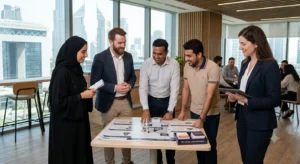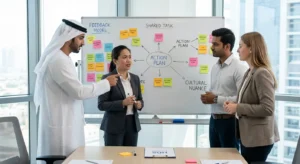
Remote and hybrid teams face a specific problem: they can communicate daily across time zones, yet still feel like strangers when they finally meet in person. Business simulations for remote teams solve this by placing distributed colleagues inside a shared, high-stakes scenario — one that demands real-time negotiation, decision-making under pressure, and genuine interdependence — long before the standard icebreaker has finished its first round.
For HR and L&D leaders at companies with globally distributed workforces, the question is no longer whether to bring teams together, but how to make those in-person or hybrid moments count. A two-day offsite in Dubai is an investment. The format you choose determines whether people leave with surface-level familiarity or with the kind of trust that actually changes how they work together.
This article explains why experiential business simulations are the highest-return format for that purpose, what the mechanics look like in practice, and how to evaluate whether a simulation is the right fit for your team’s next gathering.
Why Standard Team-Building Fails Distributed Teams
Most off-the-shelf team-building activities were designed for co-located teams that already share a social fabric. For distributed teams, they tend to fall flat — and for an understandable reason.
When colleagues work across different countries and time zones, they arrive at an in-person event without the casual, cumulative social history that develops naturally in a shared office. They have professional relationships built on Slack threads and video calls, but not the informal experiences — the shared lunches, the corridor conversations, the moments of seeing how someone handles stress — that build genuine psychological safety. Dropping that group into a quiz night or a cooking class produces surface engagement. It does not produce the vulnerability and shared risk that trust actually requires.
Research consistently shows that trust in distributed teams develops primarily through what researchers call “swift trust” — a form of conditional reliance based on role competence and task performance rather than interpersonal history. The implication for L&D design is important: if you want distributed colleagues to trust each other as people, you need to create a structured environment where they face real decisions together, observe how each person thinks under pressure, and experience collective success or failure. That environment is exactly what a well-designed business simulation creates.
What Business Simulations for Remote Teams Actually Look Like
Business simulations for remote teams are structured, facilitated experiences in which participants work through a realistic business challenge — a market entry decision, a crisis scenario, a competitive negotiation — using roles, constraints, and consequences that mirror those of real organisational life.
Unlike a workshop or a lecture, a simulation does not ask participants to learn about something. It asks them to perform. Decisions have in-scenario consequences. Teams that fail to communicate effectively lose ground to competitors. Leaders who hoard information create bottlenecks that become visible to the whole group. The debrief — always the most critical part of a well-run simulation — then turns those lived moments into transferable insight.
For distributed teams specifically, the design of the simulation matters enormously. The most effective formats for hybrid or periodic in-person gatherings share several structural features:
- Interdependent roles across subgroups — participants cannot succeed alone; they need information held by someone on the other side of the room (or screen).
- Time pressure and incomplete information — replicating the conditions of real cross-functional work, where no one has the full picture.
- Visible stakes — scorecards, competitive dynamics, or shared consequence structures that make performance real rather than hypothetical.
- Structured debrief with behavioural anchors — facilitated reflection that connects what happened in the simulation to specific team dynamics back in the workplace.
HDS Learning’s immersive simulation experiences are designed around exactly these principles — combining competitive business game dynamics with facilitated reflection to produce behavioural change that outlasts the event itself.
The Specific Challenges of Hybrid Team Integration in Dubai
Dubai’s corporate landscape presents a distinct context for distributed team challenges. Many multinationals operating in the UAE run regional teams that span Dubai, Abu Dhabi, and beyond — with some team members based locally and others flying in periodically from Europe, Asia, or Africa. The result is a team structure that is neither fully remote nor fully co-located: it is permanently hybrid, with rotating membership in the physical space.
This creates three recurring problems for HR and L&D leaders:
- Unequal social capital — employees based in the Dubai office accumulate informal influence and relationships that remote colleagues cannot access, creating invisible divisions within the team.
- Communication asymmetry — local team members develop shorthand and working norms that make sense in-office but exclude or confuse those joining remotely.
- Trust decay between gatherings — without regular face-to-face contact, the trust built during one offsite gradually erodes before the next one, especially when the team faces conflict or ambiguity in between.
A business simulation run during a Dubai offsite addresses all three directly. By assigning roles that deliberately cut across location-based subgroups, and by creating scenarios where local and remote perspectives each carry strategic value, a well-facilitated simulation rebalances social capital in real time. Participants experience each other’s competence under pressure — which is the fastest known route to genuine professional trust.
If your team uses a scenario like Gold of the Desert, the competitive dynamics and cross-functional interdependencies built into the design do exactly this: they surface how the group actually makes decisions together, and they create a shared narrative — “remember when our subgroup nearly lost the northern route” — that becomes social glue for the months that follow.
How Experiential Learning Builds Trust That Virtual Tools Cannot
The mechanism behind this is not mysterious. Experiential learning for remote teams works because it generates what cognitive scientists call episodic memory — rich, emotionally encoded recollections of a shared event. Unlike a webinar or a slide deck, a simulation creates experiences that participants remember as stories, and shared stories are the bedrock of team identity.
There is a meaningful difference between knowing intellectually that a colleague is competent and having seen them stay calm and think clearly when the simulation’s market collapsed without warning. The second experience builds trust in a qualitatively different way. It gives team members a behavioural reference point that they carry back into their distributed working relationships.
This is why companies that invest in corporate simulations for distributed teams consistently report that the benefit outlasts the event. The investment is not in the two days of the offsite. It is in the changed quality of interaction for the six to twelve months that follow — fewer miscommunications, faster conflict resolution, more willingness to escalate problems early rather than let them fester across time zones.
For L&D leaders tracking the impact of corporate training, this is also the framing that makes business simulations defensible to finance. The question is not “what did this cost?” but “what does improved trust and communication across our distributed teams produce in operational terms?” — faster decisions, reduced duplication, higher retention among high-performers who feel genuinely connected to their colleagues.
Mid-Funnel CTA
If you are planning a leadership offsite or team integration event in Dubai and want a format that generates measurable behavioural change — not just a memorable day — speak with the HDS Learning team about designing a simulation experience tailored to your team’s specific challenges.
Designing a Business Simulation for Your Distributed Team: What to Look For
Not all simulations are equal. When evaluating providers of experiential learning for remote teams, the key differentiators sit in the design details — not in the production value of the materials.
The following criteria separate high-impact simulation experiences from those that deliver entertainment without lasting change:
- Custom scenario relevance — the business context of the simulation should be close enough to the team’s actual industry and challenges that participants immediately suspend disbelief and engage fully.
- Facilitator quality — the debrief is where learning happens. A skilled facilitator can surface the exact moments in the simulation where team dynamics broke down and help participants articulate what they would do differently.
- Hybrid delivery capability — for teams where some members cannot travel to Dubai, the simulation design should accommodate mixed in-person and virtual participation without creating a two-tier experience.
- Measurement and follow-through — the provider should offer a framework for measuring behavioural change post-event, not just participant satisfaction scores.
- Customisation of learning objectives — whether the focus is conflict resolution, decision-making under pressure, or cross-functional communication, the simulation’s mechanics should be calibrated to those specific outcomes.
HDS Learning’s full experience portfolio covers each of these criteria with programmes that range from competitive business game formats to strategic leadership scenarios — all designed to be adapted to the specific context and composition of the team.
Frequently Asked Questions
Can business simulations be run in a hybrid format, with some participants in Dubai and others joining remotely?
Yes — the most effective designs for hybrid team integration explicitly accommodate mixed participation. The key is that the simulation’s interdependencies must be structured so that remote participants hold information or capabilities that in-person participants genuinely need, rather than being passive observers. This requires deliberate facilitation design, not just video conferencing added onto an in-person format.
How long does a business simulation typically take for a distributed team offsite?
Most formats run between four hours and two full days, depending on the depth of the scenario and the number of debrief cycles. For distributed teams with limited time together, a half-day simulation followed by a structured debrief is often the most efficient format — producing focused, high-quality shared experience rather than stretching engagement over a longer period.
What is the ideal team size for a business simulation?
Most formats work well with groups of 12 to 40 participants. Smaller groups (12–16) allow for more granular role-based dynamics; larger groups can be divided into competing business units, adding a competitive layer that raises engagement and surfaces inter-team dynamics relevant to real-world collaboration.
How does a simulation create psychological safety for remote team members who don’t know each other well?
The structure of the simulation itself does much of this work. When participants are assigned roles within a scenario — rather than being asked to perform as “themselves” — the cognitive and social load of the new environment drops. They can demonstrate competence through the character of their role, which creates a low-risk entry point for building real confidence and connection with colleagues they have only met on video calls.
How is the impact of a business simulation measured after the event?
The most meaningful measurement approaches combine participant reflection surveys taken immediately post-event with manager-assessed behavioural observations three to six months later. Specific indicators to track include speed of escalation for cross-team conflicts, frequency of proactive cross-functional communication, and self-reported trust levels within the team. HDS Learning provides structured frameworks to support this post-event measurement.
Are business simulations relevant across different cultural backgrounds in UAE-based international teams?
Designed well, yes. The best simulations use business scenarios with universal strategic logic — competition, resource allocation, decision-making under uncertainty — that transcend cultural specificity. The debrief is where cultural context becomes most valuable: exploring how different team members approached the same decision differently, and what that reveals about communication styles and decision-making norms, generates some of the richest learning in a multicultural environment.
The Case for Making Your Next Dubai Offsite Count
Distributed teams will always face the challenge of building connection across distance. The question is whether the time they spend together in person is used to its full potential or treated as an operational necessity — a logistical gathering that feels good in the moment but leaves no lasting mark on how people work together.
Business simulations for remote teams shift that equation. They convert a gathering into a shared challenge — one with real stakes, genuine interdependency, and the kind of collective experience that participants carry back into their distributed working relationships for months. For HR and L&D leaders evaluating the return on an offsite investment, this is the format that closes the gap between team presence and team performance.
Connect with the HDS Learning team to explore how a tailored simulation experience can be designed for your next Dubai offsite — and to find out which scenario format best matches your team’s specific integration challenges.