
ntroduction
Organisations invest significant time and resources in training programmes every year. Teams attend workshops, complete courses, and participate in development initiatives designed to improve performance.
Yet many organisations face the same challenge: people leave inspired, but very little changes once they return to their day-to-day work.
The problem is not a lack of learning. The problem is that learning alone does not automatically create behavioural change.
To create lasting impact, organisations need development experiences that move beyond information transfer and help people apply, practise, and reinforce new behaviours in real-world situations.
The Gap Between Learning and Behaviour Change
Traditional training often focuses on delivering knowledge.
Participants listen, take notes, and understand new concepts. While this can increase awareness, awareness alone rarely changes how people lead, communicate, collaborate, or make decisions.
Real behavioural change requires:
- Active participation
- Reflection and feedback
- Practice in realistic situations
- Team collaboration
- Reinforcement over time
Without these elements, learning can quickly fade and employees often return to familiar habits and behaviours.
Why Experiential Learning Creates Stronger Results
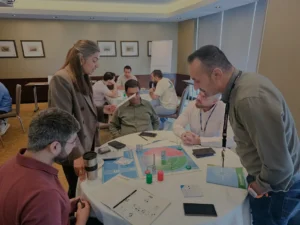
Experiential learning places participants in realistic challenges where they must actively engage, collaborate, solve problems, and make decisions.
Instead of discussing concepts in theory, participants experience them directly.
This approach creates stronger emotional engagement and deeper learning because people learn through action rather than observation.
Experiential learning helps teams:
- Improve collaboration
- Strengthen communication
- Develop leadership capabilities
- Increase adaptability
- Build confidence in decision-making
- Align around shared goals
When people experience challenges together, learning becomes more meaningful, memorable, and practical.
From Individual Development to Organisational Transformation
The most successful organisations do not view learning as a standalone activity.
They see development as a tool for creating broader organisational outcomes.
Effective learning experiences can contribute to:
Leadership Alignment
Strong leadership teams create consistency, clarity, and direction across the organisation.
Behavioural Change
Learning should influence how people think, communicate, collaborate, and perform in their daily work.
Culture Development
Shared experiences help reinforce organisational values and encourage desired behaviours.
Organisational Capability
Teams develop the skills, confidence, and mindset needed to respond to future challenges.
Creating Learning That Lasts
Lasting development requires more than a single workshop or event.
Organisations achieve stronger outcomes when learning is part of a broader journey that includes reflection, reinforcement, application, and ongoing development.
By combining immersive experiences with practical learning and long-term capability building, organisations can create meaningful change that extends beyond the learning environment.
Conclusion
Learning should do more than transfer knowledge.
It should strengthen leadership, improve collaboration, shape behaviours, and create lasting organisational impact.
Experiential learning provides organisations with a powerful way to transform learning into action, helping teams develop the capabilities needed to succeed in an increasingly complex business environment.
When learning becomes experience, development becomes transformation.
SEO Title: Why Traditional Training Rarely Creates Lasting Behavioural Change
Meta Description: Discover why traditional training often fails to create lasting behavioural change and how experiential learning helps organisations strengthen leadership, collaboration, and long-term performance.
Focus Keywords: experiential learning, behavioural change, leadership development, organisational transformation, team development, leadership alignment, organisational growth