
The world of leadership development is evolving. Traditional training programs have failed to deliver measurable business impact, often resulting in a disconnect between learning content and real-world application. So, what makes a training program truly effective in transforming leadership skills?
The answer lies in a holistic, experiential learning approach that goes beyond knowledge acquisition to focus on behavior change, leadership adaptability, and strategic business impact. At the heart of this transformation lies the importance of designing training that is aligned with organizational objectives, fosters ongoing growth, and measures tangible results.
1. Aligning Training Programs with Strategic Objectives
An effective leadership development program must align with the organization’s broader strategic goals. In the case of the bank’s management development program, the objective was clear: strengthening line management capability to enhance engagement, accountability, and business performance. This objective was supported by the need for improved leadership consistency, cultural transformation, and organizational agility.
Programs that connect directly to the business’s core needs (such as employee engagement, team performance, and leadership excellence) create a direct link between leadership development and organizational success. By identifying these key areas upfront, businesses ensure that the training is relevant and can drive strategic transformation.
For companies in Dubai’s competitive corporate environment, business simulation training Dubai offers a powerful way to prepare managers and executives for complex leadership responsibilities.
2. Experiential Learning: Bridging the Gap Between Theory and Practice
Leadership development is not just about knowledge. It requires judgment, communication, and the ability to respond to uncertain situation.
One of the key ingredients for success in leadership development is the use of experiential learning. Traditional training often fails to engage participants because it focuses on theoretical knowledge without giving leaders the opportunity to apply what they’ve learned in real-world situations.
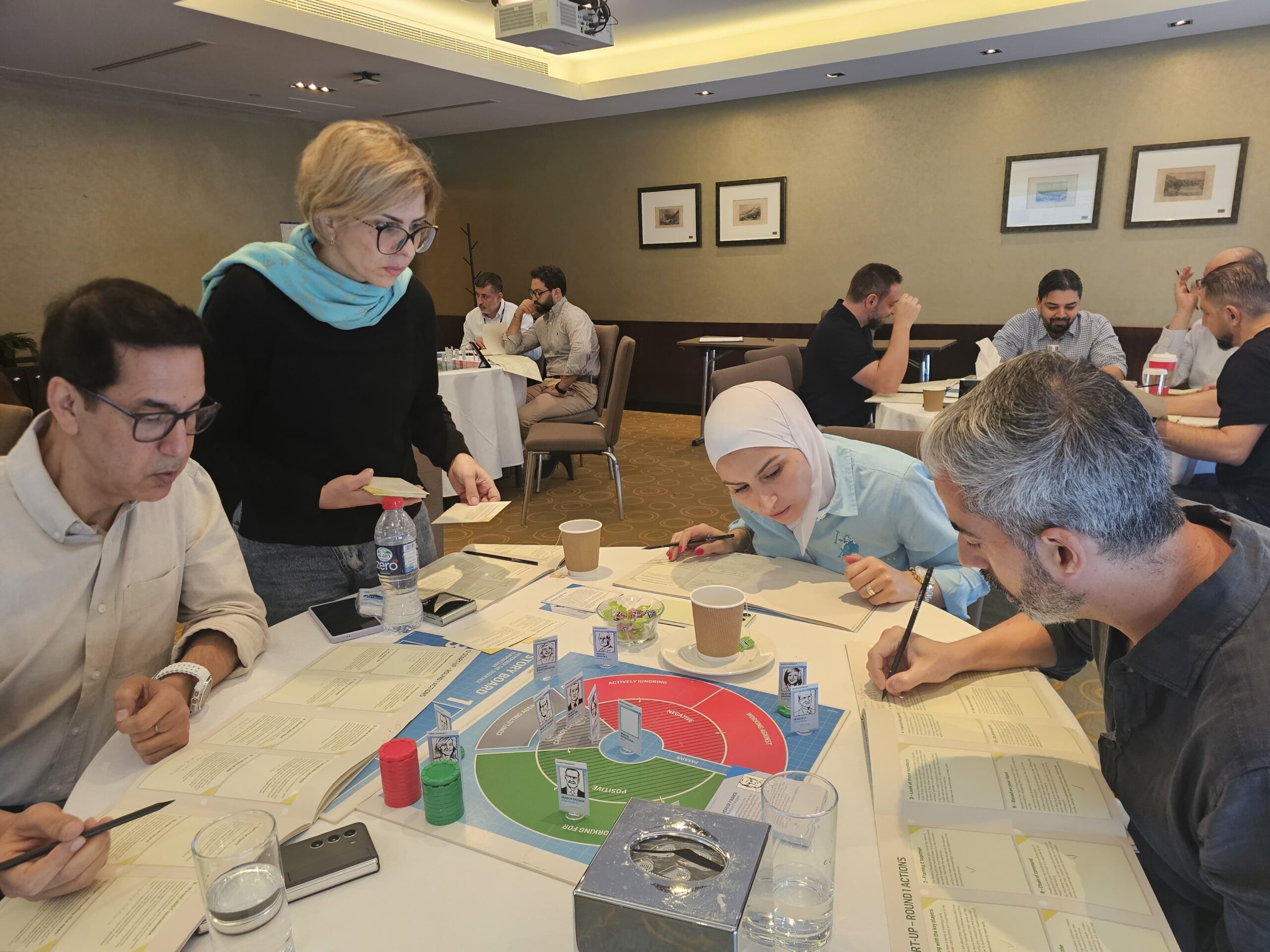
The Management Development Program introduced by the bank demonstrates how simulations, role plays, and hands-on assignments can bridge the gap between theory and practice. For example, the NAVIGATOR international simulation and other experiential activities focused on practical decision-making, conflict resolution, and performance management, allowed participants to practice leadership in real-time scenarios. This approach promotes learning through active engagement, enabling managers to experience challenges firsthand and gain insights into their own behavior and leadership style.
By embedding real-world applications into leadership programs, experiential learning ensures that participants can transfer new skills directly into their day-to-day work.
3. Continuous Feedback and Follow-Up for Sustainable Growth
Effective leadership development is not a one-time event. To ensure long-term behavior change, programs must include ongoing feedback and follow-up mechanisms that reinforce learning over time.
The bank’s program used on-the-job assignments, follow-up coaching sessions, and regular manager involvement to track progress and provide actionable feedback. This ensures that learning doesn’t stop when the formal training modules end. Instead, the feedback loop enables real-time application of skills, fostering continuous development and a culture of accountability.
By establishing a system that encourages feedback integration and manager support, organizations can ensure that training becomes an ongoing learning journey, not just a one-off event.
4. Measuring Success: KPIs Beyond Knowledge Acquisition
Another common pitfall in traditional leadership training is the lack of clear, measurable outcomes. Organizations must go beyond satisfaction surveys and knowledge tests to measure the impact of training on actual leadership behavior and business performance.
The Management Development Program employed both quantitative and qualitative KPIs to assess the ROI of the program. These included:
- Pre- and post-assessments to evaluate knowledge gain
- On-the-job assignments to track skill application
- Performance evaluations from managers to validate behavioral change
Furthermore, participant feedback was gathered throughout the journey, providing real-time insights into how well the training was resonating and where adjustments were needed.
By tracking the impact on both individual behavior and team performance, companies can assess the true effectiveness of leadership programs and determine their ROI.
5. Building a Coaching Culture for Long-Term Success
While technical skills and leadership frameworks are crucial, the ability to coach and mentor others is what truly differentiates great leaders from mediocre ones. The Management Development Program put a strong emphasis on coaching and feedback, enabling participants to develop these critical interpersonal skills.
Leaders who can effectively coach and mentor their teams, provide constructive feedback, and create an environment of open communication will drive higher engagement, innovation, and performance. The bank’s program helped participants practice these skills through role-playing, feedback sessions, and discussions.
By focusing on people development alongside leadership strategy, companies create a culture of continuous improvement, where every leader becomes a mentor who actively fosters the growth of others.
6. Scaling Leadership Development Across Sectors
DWhile the bank’s leadership development program was designed with a focus on the banking sector, its core elements are universally applicable across industries. The key ingredients for success – such as tailored learning, experiential learning, feedback mechanisms, and alignment with strategic goals – can be adapted to any organization seeking to develop high-performing leaders.
By focusing on universal leadership challenges, such as engagement, performance management, and change leadership, organizations across various sectors can implement similar programs that are designed to foster long-term growth and business success.
Transforming Leadership for the Future
Transforming leadership development it’s about creating an environment where learning becomes a journey, one that encourages continuous application, feedback, and accountability.
By incorporating experiential learning, continuous coaching, measurable outcomes, and alignment with business strategy, companies can develop leaders who are capable of driving transformation, fostering engagement, and delivering tangible results.
As we look toward the future, it is clear that the key to effective leadership development lies in creating programs that not only teach skills but also transform behavior, building leaders who can lead with impact in a constantly changing world.
Conclusion
Lead
FAQ: Business Simulation Training in Dubai
1. What is business simulation training?
Business simulation training is an interactive learning method where participants manage simulated business scenarios to develop leadership, strategic thinking, and decision-making skills.
2. Why is business simulation training important for leadership development?
It allows leaders to practice real world decision making, experience consequences, and improve problem solving skills in a safe learning environment.
3. Who should attend business simulation training in Dubai?
Managers, team leaders, executives, and high potential employees who are preparing for leadership roles can benefit from this type of training.
4. How long does a business simulation training program usually last?
Programs can range from a few hours to multi day workshops, depending on the complexity of the simulation and learning objectives.
5. What skills can participants develop through business simulations?
Participants improve strategic thinking, financial decision making, teamwork, communication, and adaptability.
6. Is business simulation training suitable for all industries?
Yes. Simulations can be customized for various industries including finance, logistics, technology, healthcare, and hospitality.
7. How does business simulation training improve team collaboration?
Participants work in teams to solve business challenges, which strengthens communication, coordination, and problem solving among team members.
8. Why is business simulation training popular in Dubai?
Dubai’s competitive and fast growing business environment requires leaders who can make strategic decisions quickly, making simulation training highly valuable.
Written by Human Development Solution, experiential learning and leadership development specialists with extensive experience designing business simulations for companies and customized learning journeys for organizations across the Middle East.